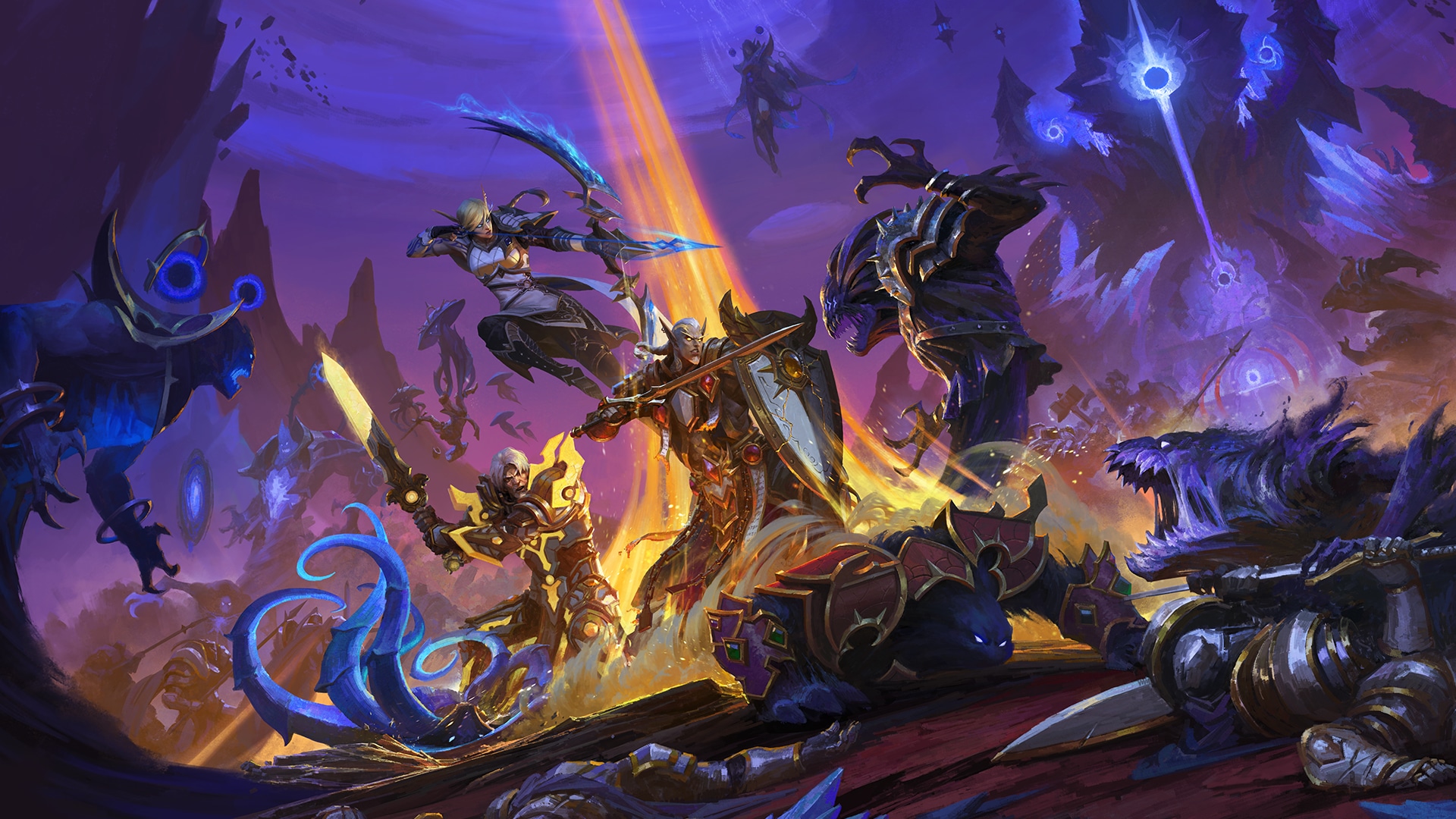
World of Warcraft
Got a phone and WiFi? WoW's TCP model means every spell waits for server confirmation — your interrupt only lands if the round-trip completes before the cast finishes. PingAim routes Wow.exe through whichever interface reaches Blizzard's datacenters fastest.
Does PingAim Help in World of Warcraft?
More about Blizzard Wardenhow it works · what it blocks · known conflicts
Warden runs as a module within the WoW.exe process at user-mode level — it is NOT kernel-level anti-cheat (unlike Riot Vanguard or BattlEye kernel mode). Warden performs periodic memory scans of the game process, enumerates loaded modules, verifies code integrity via hashing, and detects external processes that interact with game memory. It also includes a malware/keylogger scanner. Scan results are hashed and sent to Blizzard servers for analysis. Because it operates in user mode, sophisticated kernel-level tools can evade it, which is a known limitation.
VPN and network optimizers
Blizzard's Terms of Service do not explicitly ban VPNs or network optimizers for connectivity improvement. However, using a VPN to bypass regional restrictions, circumvent game access in blocked regions, or engage in account sharing/boosting violates ToS and can result in bans. Players using VPNs purely for latency reduction report no bans. Sudden account region changes may trigger a security review/temporary lock.
Known software conflicts
- AddOns that read protected memory regions get flagged by Warden
- Bots and automated input tools are actively detected and result in bans
- VPN IP addresses from datacenters may trigger account security review
- Some AV/security software that hooks game processes can be flagged
- Anti-cheatWarden
- ProtocolBOTH
- Tick rate20 HZ
- ConnectionDedicated
- HostingBlizzard Entertainment (own in…
- EngineCustom in-house engine
- NATModerate
- LauncherBattle.net
- Install size80 GB
Why ping matters in World of Warcraft
Latency sensitivity MediumPing matters but is not the dominant factor.
WoW is an MMO with a server-authoritative TCP model and no lag compensation, meaning every spell cast and action requires a round-trip to the server before it takes effect. At ping above 100ms, spell GCD queuing and ability responses feel sluggish. In Mythic+ dungeons and arena PvP, 50ms vs 150ms is clearly noticeable — interrupts, defensives, and CC timing all depend on reaction windows measured in hundreds of milliseconds. However, WoW is far more forgiving than competitive FPS games: the 1.5-second GCD gives players a natural buffer, and raids can be completed comfortably at 120ms. The 'medium' rating reflects that latency matters noticeably but doesn't make the game unplayable in the way it would for CS2 or Valorant.
About World of Warcraftbackground, studio, esports scene
World of Warcraft (WoW) is a massively multiplayer online role-playing game (MMORPG) developed and published by Blizzard Entertainment, first released on November 23, 2004. Set in the high-fantasy Warcraft universe, players create characters from a variety of races and classes, exploring an evolving open world of zones, dungeons, and raids. The game has released eleven major expansions, with the current one being Midnight (2026), the second part of the Worldsoul Saga trilogy. Core activities include questing, Mythic+ timed dungeons, 10–30 player raids, battleground and arena PvP, and crafting professions.
WoW operates on a regional server model with separate client versions for Retail (current expansion) and Classic (legacy versions: Classic Era, Season of Discovery, Cataclysm Classic). The game communicates over TCP/UDP using Blizzard's own Battle.net platform for authentication on port 1119, while game world traffic flows over port 3724. Unlike most modern online games, WoW uses TCP as its primary in-game protocol — a historically unusual choice justified by the MMO's state-synchronization model and lower frame-rate demands compared to competitive shooters.
With over 20 years of history, WoW defined the modern MMORPG genre. At its peak (Wrath of the Lich King era, 2008–2010) it held approximately 12 million subscribers. The game has seen a resurgence under the Dragonflight, The War Within, and Midnight expansions after the poorly-received Shadowlands period, and maintains a competitive PvP scene (Arena World Championship) and PvE scene (Race to World First). It remains one of the highest-grossing games of all time.
- Studio
- Blizzard Entertainment
- Released
- 2004
- Platforms
- Windows, macOS
- Engine
- Custom in-house engine
- Esports
- Tier 2 — established scene
Explore the World of Warcraft Guide

PingAim detects World of Warcraft automatically
No manual config. PingAim identifies World of Warcraft by process name and routes it through your fastest connection using a kernel-level WFP driver.
When does PingAim help — and when doesn't it?
PingAim helps when...
- Phone 5G tethering — route Wow.exe through mobile when home WiFi is congested during raid progression
- WiFi and Ethernet both active — PingAim selects whichever interface reaches Blizzard's Chicago or Paris nodes with lower latency
- Streaming or downloads on main connection — separate WoW traffic so arena interrupts aren't delayed by congestion
- Evening congestion causing jitter spikes that break interrupt timing in Mythic+ and arena
- Dual-WAN setup — assign Wow.exe to the faster WAN independently of household traffic
- Oceanic or South American players where a second connection path reduces base latency to US or EU servers
Won't help when...
- Only one internet connection available — a second connection is required for interface selection to help
- Already below 80ms on your home region server on the current connection
- Realm queues or server-side lag during major patch releases — server-side issue, no routing fix helps
- WoW's own server-side performance issues shown as elevated World latency in the minimap tooltip
Related Games
Other games sharing technical traits with World of Warcraft — anti-cheat, hosting, engine, or genre.

Community & Official Resources
Where players talk and where the publisher posts updates.
Glossary11 terms used on this page
- AWC
- Arena World Championship — WoW's top PvP esports event.
- GCD
- Global Cooldown — the 1.5 second shared cooldown after casting most abilities. High latency pads this with network round-trip time.
- Home Latency
- WoW's metric for your ping to Battle.net front-end servers. Less gameplay-relevant than World latency.
- MDI
- Mythic Dungeon International — WoW's top PvE (Mythic+) esports event.
- Mythic+
- Timed dungeon scaling system requiring precise ability timing — one of the most latency-sensitive PvE activities in WoW.
- Phasing
- Content visibility system where players in different quest states see different versions of the world. Server-side and not network-related.
- Realm
- WoW's term for an individual game server/world. Characters are created on specific realms but can group across realms via cross-realm matchmaking.
- Sharding
- Technology that splits crowded zones into multiple instances, routing players to different backend servers. Can cause sudden latency changes when moving between shards.
- Spell Batching
- Historical mechanism where spells were processed in batches per server tick (400ms originally). Reduced to 10ms in WoW Classic 2019.
- Warden
- Blizzard's proprietary user-mode anti-cheat system that scans WoW.exe process memory for cheats and bots.
- World Latency
- WoW's in-game metric for your ping to the game world server. The latency that matters for gameplay. Shown by hovering over minimap chat icon.